Executive summary
Legal context
An ECO is “any person who owns, operates or manages digital or electronic facility or platform for electronic commerce” (Section 2(45), Central Goods and Services Tax Act, 2017 (“CGST Act”)). Under Section 9(5), the Government may notify services on which the operator, rather than the actual supplier, pays the tax. The services currently notified are passenger transport, accommodation, housekeeping, restaurant and local delivery services (Notification No. 17/2017-Central Tax (Rate), as amended).
Council’s recommendations:
- Operator liability independent of business model
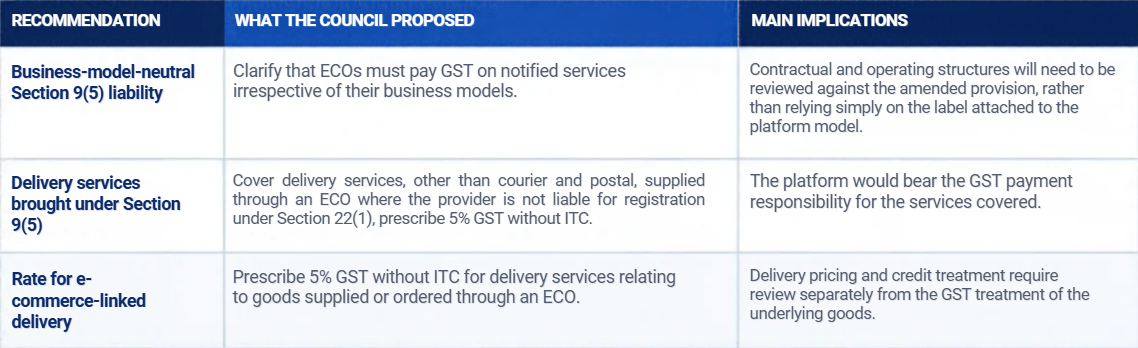
To address uncertainty surrounding the applicability of Section 9(5) of the CGST Act to different business models, the Council recommended a formal amendment to the provision.
- Reform: The amendment is intended to provide clarity on the liability of an operator to pay tax on notified services, irrespective of the business model it follows.
- What prompted this clarification? The shift by ride-hailing platforms from per-ride commissions to fixed subscription fees raised questions about whether Section 9(5) applies to the model. Platforms contended that passenger transport services were not supplied “through” them under this arrangement, with conflicting rulings by Authorities for Advance Ruling adding to the uncertainty. The issue reached the Karnataka High Court, which directed the representations to be considered; given the implications for the States, the matter was then placed before the GST Council for clarification.[2]
Being a statutory amendment, it requires amendment of the CGST Act by Parliament and of the SGST Acts by the State legislatures.
- Rationalisation of GST rates on delivery and transportation services
- Delivery services (other than courier and postal) supplied through an ECO by a person not liable to register under Section 22(1) would be brought under Section 9(5), at 5% GST without ITC. This marks a major shift from the 56th GST Council recommendations and subsequent September 2025 notifications, which had brought “local delivery” services supplied through an operator under Section 9(5), at 18% GST.
The wider expression “delivery services” should address the ambiguity around what qualifies as “local delivery services”, which had also prompted the industry to seek clarifications last year. It should also prevent platforms from contending that inter-city or non-local deliveries fall outside Section 9(5).
- Delivery services in relation to goods supplied or ordered through an ECO would attract 5% without ITC. This ensures that the uniform 5% rate is not person-specific: the operator pays it under Section 9(5) where the delivery partner is unregistered, and a registered delivery partner pays it directly.
A key question that arises here is the GST liability and rate applicable on services of transportation of goods by a Goods Transport Agency (“GTA”) supplied in relation to goods supplied/ordered through an ECO. In such cases, the liability will be on the GTA and not the operator, and the rate applicable will be 5% without ITC, or 18% with ITC where the GTA opts to pay tax under forward charge, as clarified in the FAQs on issues related to services dated 9 October 2026. The Council also recommended that the exemption under Entry 21A of Notification No. 12/2017-Central Tax (Rate) will not be available for such services provided to unregistered persons. The exemption will, however, continue for GTA services in relation to goods not supplied or ordered through an ECO.
The limitation is “notified services”
The proposal does not say that ECOs become liable for GST on every supply routed through their platforms. The official wording retains the category of notified services. That limitation is crucial when distinguishing the seller’s goods supply, the platform’s own services and a delivery provider’s service.
The release also does not announce a retrospective commencement date or retrospective validation for this particular amendment. Existing-period disputes cannot be treated as resolved merely because the proposed change is described as providing clarity.
Why “without ITC” matters commercially
The proposal pairs a low output rate with a restriction on input tax credit for the specified delivery service. Businesses should therefore evaluate the combined effect of the output tax and the credit restriction, rather than assuming a 5% rate necessarily reduces the total tax cost. The precise restriction and allocation mechanics must come from the implementing notification.
It would also be premature to conclude that every recipient is barred from taking credit of GST charged on delivery: the release does not set out the detailed recipient-side treatment.
Next steps for ECOs
For impact assessment, platforms should examine arrangements such as:
- Commission-based marketplaces;
- Subscription or access-fee models;
- Direct payment between customers and service providers;
- Separately contracted service and delivery arrangements.
These are suggested review categories—not a statement that the Council expressly listed or conclusively resolved each one.