PhonePe Vs. BharatPe Case: No Exclusivity Over a Part of a Mark, Not Even by Misspelling It

Registration of the (whole) mark does not confer an exclusive right over a part of a registered mark. Similarly, no exclusivity can be claimed over a descriptive mark or a descriptive part of the mark, not even by misspelling it. This was the ruling of the Delhi High Court in a recent Trademark Infringement & Passing Off matter between PhonePe Pvt. Ltd. (Plaintiff) & Ezy Services & Anr. (Defendants). Hon’ble Justice C. Hari Shankar affirmed some of the fundamental principles of the Trademark Law, which have been asserted by various Courts from time to time.
PhonePe’s Perception:

PhonePe in its plea before the Delhi High Court stated that: a consumer of average intelligence and imperfect recollection, on seeing the defendants’ mark BharatPe would immediately associate it with PhonePe.

Well, how often is our intelligence questioned and challenged, even without our knowledge? Considering the deep inroads that technology has made into our lives now, I reckon all of us are reasonably aware of the prominent digital wallets in the market. Knowing that, it is contestable how many of us would have wondered about any association between these two marks purely based on the similarity in their suffix “Pe”.

Background:

The plaintiff had filed a suit before the Delhi High Court seeking a permanent injunction and other remedies against the defendants’ use of ‘Pe’ or any deceptive mark identical and/or similar to the plaintiff’s trademark ‘PhonePe’. The plaintiff alleged that the use of the word “BharatPe” itself, infringed the plaintiff’s registered trademark and amounted to passing off.

The plaintiff in its suit claimed that “Pe” is an essential, dominant, and distinguishing feature of the plaintiff’s registered trademarks. Plaintiff further claimed that “Pe” is an invented word, not to be found in the English dictionary and when combined with “Phone”, which is an ordinary dictionary word with a well-known meaning, “Pe” becomes the dominant and essential feature of the plaintiff’s trademark “PhonePe”.

Court’s Findings and Rulings:

The Hon’ble Delhi High Court’s decision in this matter seems to be premised based on following three principles, which have already been established earlier in multiple Judgments by various Courts:

a) The Anti-Dissection Rule:
The Hon’ble High Court observed that the registered mark ought not to be dissected for the purpose of comparison with the conflicting mark. However, the Court acknowledged the exception of “dominant mark” test, under which, if any part of the plaintiff’s mark was found to be dominant, the Court was required to examine whether such dominant part of the plaintiff’s mark was infringed by the defendant’s mark.

The plaintiff contended that “PhonePe” was a combination of the words “Phone” and “Pe”, where “Phone” was a common dictionary word and the suffix “Pe” was not a dictionary word, which made it the dominant feature of the plaintiff’s trademark. Similarly, in the defendant’s trademark, the word “Bharat” was publici juris and “Pe” formed the dominant element of the mark “BharatPe”. However, the Court was not convinced on the argument and did not find “Pe” to be the dominant part, therefore, the marks were not allowed to be dissected for the comparison.

The Court ruled that while applying the above principles to the facts in hand, the following positions emerged i.e. (i) “PhonePe” and “BharatPe” were both composite marks. (ii) the marks could not be dissected into “Phone” and “Pe” in the case of the plaintiff and “Bharat” and “Pe” in the case of the defendants; and (iii) the plaintiff could not claim exclusivity over the word “Pe”, as it was merely a misspelling of the word “Pay”, hence no infringement could be claimed on the basis of part of a registered trademark.

b) Separate Registration of a Part of a Composite Mark:
The Hon’ble Court further observed that since the plaintiff did not have any registration over the suffix “Pe”, therefore, it could not claim any exclusivity on the same. As a result, the question of infringement did not arise because of the alleged similarity between the non-essential, unregistered part of the composite mark.

In the cases of South India Beverages1 and P.K. Overseas Pvt. Ltd.2, the Delhi High Court explained the relation between the anti-dissection principle and the “dominant/essential feature” principle. The division bench relied on a passage from McCarthy on Trademarks and Unfair Competition, earlier cited in the case of Stiefel Laboratories3, which stated that “The rationale for the rule is that the commercial impression of a composite trademark on an ordinary prospective buyer is created by the mark as a whole, not by its component parts. However, it is not a violation of the anti-dissection rule to view the component parts of conflicting composite marks as a preliminary step on the way to an ultimate determination of probable customer reaction to the conflicting composites as a whole”.

c) Non-exclusivity of Descriptive or Generic Marks or Parts of Marks:
The Hon’ble Court observed that a party cannot claim exclusivity over a descriptive or generic mark or a part of the mark that is considered descriptive. The Court went on to observe that the plaintiff could not claim that the mark was non-descriptive merely by misspelling the descriptive word. However, the Court admitted an exception to this principle in situations where the descriptive or generic mark had acquired distinctiveness or secondary meaning.

The Court further observed that had the plaintiff been able to establish that the word “Pe” had acquired distinctiveness and secondary meaning, it might have been able to make out a case of infringement. However, in this case, the plaintiff’s use of the mark “PhonePe” was only since 2016 and even the defendants claimed to have extensive use of their mark “BharatPe”. Therefore, the plaintiff had not been able to make out a prima facie case.

In the case of Marico Limited4, the Court dived deep into the concept of acquired secondary meaning of a descriptive mark and held that while deciding whether a descriptive mark is registrable or not the “Courts should ordinarily lean against holding distinctiveness of a descriptive trademark unless the user of such trademark is over such a long period of time of many-many years that even a descriptive word mark is unmistakably and only relatable to one source i.e. the same has acquired a secondary meaning”.
1 South India Beverages v. General Mills Marketing, AIR 1965 SC 980
2 P.K. Overseas Pvt. Ltd. v. Bhagwati Lecto Vegetarians Exports Pvt. Ltd., 2016 SCC OnLine Del 5420
3 Stiefel Laborataries v. Ajanta Pharma Ltd, 211 (2014) DLT 296
4 Marico Limited v. Agro Tech Foods Limited, 2010 (44) PTC 736 (Del.) (DB)
The Marico case also discussed the nature and character of a misspelt word when used as a trademark and held that “if partly tweaked descriptive words and expressions of English language are claimed to be coined words, the same would result in a grave and absurd situation because a non-tweaked word being a completely descriptive word will in fact be deceptively similar to the tweaked descriptive English language word or expression of which registration is obtained”.

Conclusion:

The Hon’ble Court ruled that there was no case for grant of interim injunction against the defendants. The Court observed that except the common word “Pe” (suffix) it cannot be established that the marks “PhonePe” and “BharatPe” are confusingly or deceptively similar. Barring the suffix “Pe” these are two different words altogether with no commonality whatsoever.

The important legal positions that emerge from this decision are:
(i) In accordance with the “anti-dissection” rule, it was held that the composite marks were to be considered in their entirety rather than truncating or dissecting them into individual components/elements.
(ii) The registration of a composite mark cannot confer any exclusive rights over any part of such registered mark unless otherwise, such part is the dominant part of the registered mark.
(iii) No exclusivity can be claimed, over a descriptive mark, or a descriptive part of a mark, not even by misspelling it, unless otherwise the descriptive mark or descriptive part has attained distinctiveness, or it has acquired a secondary meaning.

This case has surely reaffirmed some of the basic principles of trademark laws that prohibit adaptation and exclusive claim over descriptive and generic marks or part of the mark.
Read about the important legal positions that emerge from the PhonePe V. BharatPe decision in this article.

Related Posts

POST A COMMENT

CBDT notifies thresholds for determining ‘Significant Economic Presence’ in India

The concept of Significant Economic Presence (SEP) was introduced under Income-tax Act, 1961 (“the Act”) vide Finance Act, 2018, by way of insertion of Explanation 2A to section 9 of the Act, to expand the scope of the term ‘Business Connection’ and includes:


  • transaction in respect of any goods, services or property carried out by a non-resident with any person in India including provision of download of data or software in India, if the aggregate of payments arising from such transaction or transactions during the previous year exceeds such amount as may be prescribed; or
  • systematic and continuous soliciting of business activities or engaging in interaction with such number of users in India, as may be prescribed.

It was further provided that the transactions or activities shall constitute significant economic presence in India, whether:


  • the agreement for such transactions or activities is entered in India; or
  • the non-resident has a residence or place of business in India; or
  • the non-resident renders services in India.

The above-mentioned Explanation was inserted primarily for establishing Business Connection in India for Multinational entities carrying out business operations through digital means, without having any physical presence in India. However, its enforceability was deferred time and again as the discussion on this issue was ongoing under G20 – OECD BEPS project. 

Notification No 41/2021/F. No. 370142/11/2018-TPL on Significant Economic Presence in India:


The Central Board of Direct Taxes (CBDT), vide its notification dated 3 May 2021[1] has stipulated Rule 11UD to prescribe the ‘revenue’ and ‘users’ threshold for the purpose of determining Significant Economic Presence (SEP) of a non-resident entity in India. It has come into force with effect from 1 April 2022 (i.e., Financial Year 2021-22 or Assessment Year 2022-23 onwards).

The threshold limit notified by CBDT for the purpose of SEP has been tabulated as under:

Sr. No.NatureThreshold Limit
1

Revenue threshold –

Transaction in respect of any goods, services or property carried out by a non-resident with any person in India including provision of download of data or software in India.

INR 2 crores
2

Number of users threshold –

Systematic and continuous soliciting of business activities or engaging in interaction with users in India

3 lakhs users

If either one of the above-mentioned thresholds is met by a non-resident entity, then such entity shall be deemed to have a business connection in India and accordingly would be liable to pay tax on income attributable to transactions or activities mentioned above, subject to the beneficial provisions of tax treaties, as may be applicable.


FM Comments:

It may be noted that this Explanation was inserted primarily with an intention to tax digital transactions which otherwise escapes tax net due to absence of physical presence in India. However, on careful reading of the provisions, it is possible to infer that SEP provisions may even cover the transactions which are carried out through non-digital means (i.e., even on ‘physical’ buying and selling of goods and services).

At this juncture, it is also imperative to mention that UN tax committee has recently approved Article 12B (Income from automated digital services) in the UN Model Tax Convention. It would be interesting to watch whether India renegotiates its tax treaties to include this Article in its tax treaties and its interplay with the SEP provisions.

Further, from a practical perspective, this provision may not have much impact on non-resident entities based out of countries with whom India has executed tax treaties, due to existence of the conventional Permanent Establishment (PE) provisions in the tax treaty, where PE exists based on the physical presence in India. It would be worthwhile to note that the provisions of section 9 of the Act does not override the provisions of tax treaty and hence unless the tax treaty is renegotiated to include provisions that are like SEP, it would not have any impact on entities based out of tax treaty countries.

Having said the above, SEP provisions could have major impact on non-resident entities based out of non-tax treaty countries as well as tax treaty countries to whom benefit under the covered tax treaty may get denied, pursuant to application of, inter alia, Article 7 – Prevention of treaty abuse of Multilateral Instrument (MLI); considering the lower threshold prescribed by CBDT, such entities may then become liable to SEP provisions and may also have to pay incremental tax in India. Additionally, those entities may then also be under obligation to undertake various tax compliances in India (such as withholding tax, filing of return of income, etc.).

The non-resident entities may face various practical challenges in determining the “revenue” and “user” thresholds and in cases where existence of Business Connection is determined based on SEP, the challenges would be in relation to attribution of profits that would be chargeable to tax in India. Accordingly, it is of paramount importance that CBDT provides adequate guidance to determine the thresholds on how the profit would be attributed to such SEP activities in India.

Last but not the least, it would be interesting to examine the interplay and co-existence or otherwise of Equalization Levy (EQL) vis-à-vis the SEP provisions. For instance, in cases where the transaction falls specifically under the EQL provisions, then such income should be exempt from tax under the provisions of the Act and accordingly the expanded scope of business connection should not apply.

The non-resident entities may face various practical challenges in determining the “revenue” and “user” thresholds and in cases where existence of Business Connection is determined based on SEP, the challenges would be in relation to attribution of profits that would be chargeable to tax in India. Accordingly, it is of paramount importance that CBDT provides adequate guidance to determine the thresholds on how the profit would be attributed to such SEP activities in India.

References

[1] Notification No 41/2021/F. No. 370142/11/2018-TPL

Image Credits: Photo by Markus Winkler from Pexels

Related Posts

POST A COMMENT

Toy Manufacturing - BIS Compliances, Schemes, and Incentives

One of the key flourishing industries in the world, India’s toy market is currently valued at $500 million out of a booming $90 billion global market. Statistics reveal that 80% of Indian toys are Chinese imports, while non-branded Chinese toys account for 90% of India’s market. Even though exports by the toy manufacturing industry from India amounted to $130 million during 2019-2020 with the USA and UK [1]being the lead exporters, the disparity and unutilized potential do not escape one’s attention.

As the second-most populated country in the world with almost 26% of its population below 15 years old, India has one of the largest consumer bases in the world. In fact, when the global average for demand growth is 4.6% [2]it is forecasted to have a growth of 13.3% CAGR [3]within 2026 i.e. almost thrice the global average. Adding on to this the toy industry of the country is also expected to reach $3.3 billion dollars by 2024!

India’s economic growth has also increased the disposable income of its citizens, thus driving up demand in a market with a whopping consumer base of roughly 338 million. Moreover, there has been a major shift from traditional, medium- to low-end battery-operated toys, towards innovative electronic toys, intelligent toys as well as upmarket plush toys.[4] The boom of e-commerce in India has also had a role to play, with customers turning to shop for toys within the comfort of their own homes.

Associations and Committees Representing the Toy Industries in India:


1.Toy Association of India

  • Headquartered in New Delhi, the toy Association of India was established in 1995 with a view to bringing together toy manufacturers, traders and end-users to promote higher business relations.
  • It has a presence all over the country and has 600 registered members, out of which 275 are toy manufacturers.
  • Assists the toy industry in up-gradation of the industry’s units with modern machinery to maintain quality standards.
  • Attempts at creating a more conducive relationship between the government and the industry by offering policy recommendations, communicating the industry’s problems in the interest and growth of the toy industry.

2.The All-India Toy Manufacturer’s Association

  • Headquartered in Mumbai, All India Toy Manufacturer’s Association has nearly 150 registered members, out of which 100 are toy manufacturers.
  • It seeks financial assistance and subsidies from the government for the growth of the toy industry, educates and encourages suppliers to conform to the BIS regulations. 
  • Encourages the organization of toy fairs and exhibitions for the promotion of the toy industry.


Compliances Requirements for Toy Manufacturing Industry under the Bureau of Indian Standards (BIS) 

Apart from the general compliances which amount to over 700 ranging from the Companies Act, SEBI Act, FEMA Act to Income Tax and Foreign Trade Act for factories and MSME’s, regulations were required to be specifically made to ensure that the toy industries are safeguarded from unfair and excessive exploitation as well as products meet the international quality requirements.

According to a study, about 67% of toys sold in India had failed all safety and standard tests, while about 30 per cent of plastic toys failed to meet the safety standards of admissible levels of heavy metals and phthalates. Phthalates are a group of chemicals.

A lack of regulation in the past had resulted in degradation of the quality of our products and failed endeavours to keep up with the international standards. However, this is no longer the case as the government has not only strengthened the existing key factors but has also set up new compliances to steer clear of the past policy miscalculations and lapses. The said compliances are as follows:

The Toys (Quality Control) Order, 2020[5]

Issued by the DPIIT, Ministry of Commerce and Industry, vide order 25 February 2020, the safety of toys has been brought under compulsory BIS certification, which is granted after the successful assessment of the manufacturing infrastructure, production process, quality control, and testing capabilities. The toys shall bear the standard mark under a licence from BIS as per Scheme-I of Schedule II, of BIS (Conformity Assessment Regulations), 2018. The said QCO was initially slated to come into effect from 1st September 2020 but was later extended to 1 January 2021[6].

Exceptions:

  • The order is not applicable to goods and articles manufactured and sold by artisans registered with the Office of Development Commissioner (Handicrafts), under the Ministry of Textiles.
  • The order is not applicable to goods and articles manufactured and sold by registered proprietor and authorized user of geographical indication, by the registrar of geographical indications, Ministry of Commerce and Industry.[7]
  •  Goods or articles manufactured/meant for export purposes.

BIS Licence and Certification

For the purpose of BIS certification, toys have been classified into the following two categories. While applying for a licence, the manufacturer can apply under any one of the classifications:


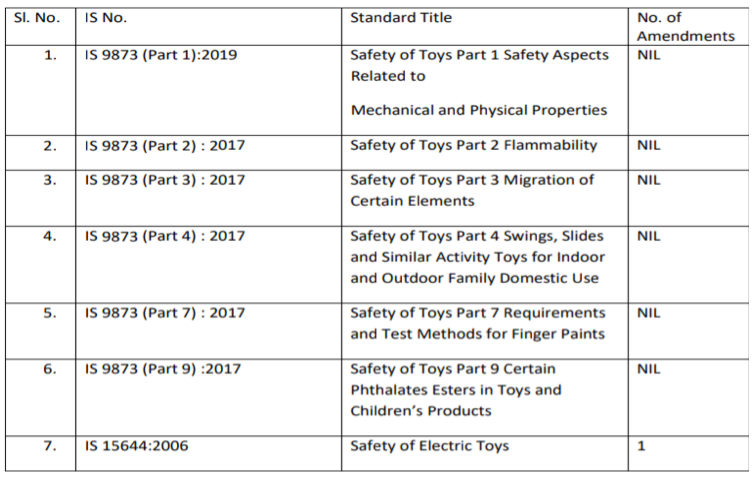
If a licence is required for more than one type of toy (i.e., non-electric and electric), separate applications shall be made for each type. (However, samples shall be tested by BIS for conformity to the primary standard and the secondary standards which are applicable i.e., IS 9873 parts 1,2,3,4,7, and 9 etc.)[1]

While applying for a license the manufacturers must also specify the type of toy in order to choose the applicable standard it would be subjected to. The specifications of toys and their corresponding standards are as follows:


For Entities Manufacturing hundreds of toy models/SKU’s
  • Since testing hundreds of toy samples individually shall prove to be practically difficult for the purpose of BIS certification. The issue has been addressed in the Product Manual for the safety of toys[1].
  • The product manual is a guidance document containing product-specific guidelines for certification. It incorporates “Grouping Guidelines” which allows certification to be granted for a group of toy models based on the testing of certain representative models.
  • These grouping guidelines have been framed based on the Indian Standard IS 9873 (Part 8):2019 which is identical with the International Standard ISO/TR 8124-8:2016 (Safety of Toys Part 8 Age Determination Guidelines) which classifies toys into 7 Categories and 146 Sub-Categories based on the appropriate starting age and the specific purpose or function of the toy.
  • For the purpose of certification, all the models of toys of similar design, made from the same materials and covered under a single sub-category, shall be considered as a series. A sample of any one model from each series shall be drawn and tested to cover all the models in that particular series.

Schemes Floated for the Toy Manufacturing Industry in India

Along with the set of existing and new compliances, the government has also introduced various schemes and incentives with the aim of promoting the industry.

Micro, Small, Medium Enterprises (MSME)

Approximately four thousand[2] enterprises in India, engaged in toy manufacturing fall under the category of micro and small-scale sectors. The MSMEs in the toy manufacturing sector is an unorganized sector, accounting for a whopping 60% of the national market share. These MSME’s are spread all across the country with a large chunk operating in the Northern and Western regions.

The Indian toy market is 70% larger thanks to the existence of MSMEs and the support they received from our government. In pursuance of the same, the government has amended the classification of MSMEs in the Aatmanirbhar Bharat Abhiyan to ensure that they receive the aid and recognition required to keep up with the changing times. The amended classification is as follows:


With the advent of Aatmanirbhar Bharat Abhiyan various schemes have been introduced to promote MSMEs:

•       Technology and Quality Upgradation Scheme: 

Enrolling in this scheme will help the micro, small and medium enterprises to use energy-efficient technologies (EETs) in manufacturing units to diminish the expense of production and adopt a clean development mechanism. The scheme guarantees to cover up to 75% of the expenditure.[1]

•       Grievance Monitoring System:

Enrolling in this scheme is advantageous when it comes to addressing complaints of business owners. Additionally, the owners may also check the status of their complaints and file an appeal if they are not satisfied with the result.

•       Incubation: 

It assists innovators in implementing their new design or product ideas. It provides financial assistance for “Business Incubators”. Financial assistance of 75 % to 85 % of the project cost, up to a maximum of 8.00 Lakh is extended to the innovators.[2]

•       Credit Linked Capital Subsidy Scheme:

Under this scheme, new technology is provided to the business owners to replace their old and obsolete technology. A capital subsidy is given to the business to upgrade and have better means to do their business. These small, micro and medium enterprises can directly approach the banks for these subsidies. The ceiling on subsidy would be Rs. 15 lakh or 15 per cent of the investment in eligible plant and machinery, whichever is lower[3]

•       Scheme of Fund for Regeneration of Traditional Industries: 

The government aims at establishing a total of 35 toy clusters in various states under this scheme. Once set up, these will boost the manufacturing of toys made of wood, lilac, palm leaves, bamboo and fabric. This scheme offers incentives such as skill development, capacity building, e-commerce assistance to local industries.

•       Product Specific Industrial Cluster Development Programme: 

The programme aims to establish dedicated SEZ’s and customize them into self-sustaining ecosystems catering to export markets.


Incentives Provided to the Toy Manufacturing Industry in India

The Centre and State governments have implemented various incentives to promote the toy industry.

A. For Toy Manufacturing Entities


1.Hiked import duty:

The import duty on toys was raised from 20% to 60% [4]making it difficult for foreign companies to compete in our market as well as making Indian companies’ entry into the market easier.

2.Handicraft and GI Toys exempted from Quality Control Order[5]:

This allows any traditionally made toys by artisans registered with Development Commissioner (Handicrafts) to be exempted from the quality compliances newly introduced.

3.Custom Bonded Warehouse Scheme:

Central Board of Indirect Taxes and Customs (CBIC) has launched a new scheme expected to play a critical role in promoting investments in India and in enhancing the ease of doing business. According to this, the unit can import goods (both inputs and capital goods) under a customs duty deferment program.[6]

4.Export Promotion Capital Goods (EPCG) Scheme: 

Enables the import of capital goods (toys/ spare parts thereof) in the pre-production, production and post-production stage without the payment of customs duty.

5.Increase in BCD for Electronic Toys (under HSN 9503) from 5% to 15%[7]:

This will increase the expenditure incurred for foreign companies to sell products in India and thus help relax the competition for Indian manufacturers. An example of how these steps have been implemented and made into a reality is the Product-Specific Industrial Cluster Development Program. An initiative taken up by the Karnataka government in partnership with Aequs Infra, is a first-of-its-kind project aimed at promoting toy industries by dedicating 400 acres of self-sustained ecosystem including an SEZ to serve export markets and Domestic Tariff Area (DTA) through state-of-the-art industrial infrastructure and facilities. It has the potential to create 40,000 jobs in five years and attract over INR 5,000 crore in investments. [8]The toy cluster aims to capitalize on the presence of key elements essential for the sector’s growth like manpower, R&D and raw material.  It is also in a strategic position to cater to 50% of the domestic toy market needs, and has an efficient connectivity network with access to highways, ports, airports, and major cities.[9] This program was touted as a one-stop-shop solution catering to the needs of both large MNCs and small and medium enterprises.

6. Duty Drawback Scheme: 

The scheme was introduced to rebate duty chargeable on any imported materials or excisable materials used in the manufacture or processing of goods, manufactured in India and exported.

B. For MSME’s

Apart from extending financial aid as discussed above, the government initiatives for MSME’s are largely based on undertaking initiatives to promote homegrown toy manufacturers and boost domestic demand for indigenous and locally produced toys. Some of these initiatives are:

Phased Manufacturing Programme (PMP): 

The programme will make the assembly of toys cheaper than imports, offering benefits similar to the PMP for mobile phones introduced back in 2015. The government has offered tax reliefs and differential tariffs among other incentives for components and accessories to push local manufacturing.

Toy Labs: 

In a bid to promote traditional toys, the government has chalked out a plan to create toy labs – a national toy fair for innovative Indian themed toys. The Atal Tinkering Lab is one such toy lab to provide support for physical toys promoting learning and innovation. Additionally, due to literacy programmes like Sarv Siksha Abhiyan and the new education policy, toys nurturing innovation and creativity are in focus.

Involving various sectors:

The education ministry has been asked to include indigenous toys as a part of learning resource, under the new education policy. The IIT’s are set to be roped in to look into the technological aspect of toys, while the NIFT’s shall study the concept of toys and national values, by using non-hazardous materials. The Ministry of Science and Technology has been directed to explore how India’s indigenous games can be featured in the digital space. While the Ministry of culture will work on ‘Indian Toy Museum’.

Labour law reforms:

The Indian toy industry is labour intensive, the new labour law reforms have a significant impact on the ease of doing business, thereby providing a competitive advantage to the Indian toy industries.

The toy industry is one sector that contains a lot of untapped potentials. The compulsory BIS certification as per the Toys (Quality Control) Order, 2020, will ensure that the quality of toys is at par with international standards along with the strengthening of existing conditions of the market. These are significant steps in the right direction to ensure that the domestic markets pick up once the pandemic wanes. The domestic production and sales could catch up with exports and thus make sure that the future of this sector will not be as grim as in the past and will light up, once again.

References 

1 https://www.investindia.gov.in/sector/consumer-goods/toys-manufacturing

2 Koppal Toy Manufacturing Cluster; https://static.investindia.gov.in/s3fs-public/2021- 01/Koppal%20Toy%20Manufacturing%20Cluster%20-%20For%20International%20Investors.pdf

3 Ibid

4 Indian Toys Market: Industry Trends, Share, Size, Growth, Opportunity and Forecast 2021-2026, https://www.imarcgroup.com/indian-toys-market

5 https://bis.gov.in/wp-content/uploads/2020/03/Toy_QC_order.pdf

6 https://dipp.gov.in/sites/default/files/orderToy-26February2021_0.pdf

7 https://dipp.gov.in/sites/default/files/QC-AmendmentOrder-Toys-21December2020.pdf

8 https://bis.gov.in/wp-content/uploads/2020/09/toys-faqs-bilingual.pdf

9 https://bis.gov.in/wp-content/uploads/2020/08/safety-of-toy.pdf

10 Toy industries in India; https://www.ibef.org/indian-toys

11 Impact of Aatmanirbhar Bharat Abhiyan on MSMEs; https://cleartax.in/s/impact-aatmanirbhar-bharat- abhiyan-msmes/

12 https://msme.gov.in/3-technology-upgradation-and-quality- certification#:~:text=Technology%20and%20Quality%20Upgradation%20Support%20to%20MSMEs&text=50%

13 https://msme.gov.in/incubation25%20of%20actual%20expenditure%20subject,licenses%20from%20National%20%2F%20International%20bodies.

14 http://laghu-udyog.gov.in/schemes/sccredit.htm

15 Budget 2020: Govt hikes customs duty on toys, furniture, footwear products; https://www.financialexpress.com/budget/budget-2020-govt-hikes-customs-duty-on-toys-furniture-footwear- products/1848123/

16 Handicraft and GI Toys exempted from Quality Control Order; https://pib.gov.in/Pressreleaseshare.aspx?PRID=1680181

17CBIC and Customs launch scheme to attract investment and support Make in India programme; https://knnindia.co.in/news/newsdetails/sectors/cbic-and-customs-launch-scheme-to-attract-investment-and- support-make-in-india-programme

18 Union budget 2021; https://www.indiabudget.gov.in/doc/budget_speech.pdf

19 https://www.investindia.gov.in/sector/consumer-goods/toys-manufacturing

20 Koppal Toy Manufacturing Cluster; https://static.investindia.gov.in/s3fs-public/2021- 01/Koppal%20Toy%20Manufacturing%20Cluster%20-%20For%20International%20Investors.pdf


Image Credits: Photo by Nguyen Bui on Unsplash

The toy manufacturing industry is one sector that contains a lot of untapped potentials. The compulsory BIS certification as per the Toys (Quality Control) Order, 2020, will ensure that the quality of toys is at par with international standards along with the strengthening of existing conditions of the market.

Related Posts

POST A COMMENT

BigBasket Vs. Daily Basket Saga

Perils of using generic/descriptive terms as a “Trademark”

On February 21, 2021, when Ramesh Vel, the founder of a Coimbatore based startup “Daily Basket” tweeted about BigBasket’s alleged bullying through a cease & desist notice, no one ever thought that it would become such a big issue. Even before the news could spread, Daily Basket was prompt enough to create a page https://bbisabully.com/ to put forth their perspective and even posted a copy of the notice. They did not stop at this but went on to launch an online campaign #BoycottBigBasket.

This prompt and aggressive move surely garnered sympathies as well as support for Daily Basket and BigBasket was at the receiving end as it was perceived as a bully in the entire episode. Though it may not have caused any impact on BigBasket’s revenue, the Company cannot deny that the episode did put a dent in its brand reputation.

The Notice:

The cease & desist notice dated Feb 17, 2021, was sent to the startup Letsdaily India Private Limited, asking them to refrain from using the mark “Daily Basket” and any other name or a mark containing the term “Basket” and also sought Rupees Two Lakhs towards the cost of the legal notice.

Who owns/claims what?

Before analyzing the matter, let us understand the claims and ownerships over the subject marks.

Looking at the trademark database, BigBasket seems to have registered several variants of its brand “BigBasket” in various classes i.e. 29, 30, 31 & 35 (food & related goods and online marketplace). However, the record does not show or mention any use or registration of the term “Basket” by BigBasket independently.

Daily Basket claims to have started its business around August 2020 but there is no record of any trademark application/registration by them.

The term “Basket”:

Currently, there are two “Basket” marks that seem to have been registered in India; one being in Class 35 where the application is dated 2014 (appl. no. 2779571) and the other one in Class 31 where the application is dated 2017 (Appl. no. 3470365).

The mark “Daily Basket”:

With regard to the mark “Daily Basket”, currently there are 3 marks in the records of Trademark Registry in Class 35. The first “Daily Basket” mark (appl no. 1807585), which was filed way back in 2009, could not proceed to registration and the same stands abandoned.

The other “Daily Basket” mark (appl. no. 3042971), which stands “registered”, was filed in the year 2015. The third “Daily Basket” mark, which was filed in the year 2017, (app. no. 3491637) was refused registration due to various reasons including the presence of conflicting marks in the same class.

Interestingly, during the prosecution of the last two marks, the examiner did not cite “BigBasket” as a conflicting mark even though BigBasket’s trademarks were on record or registered during that period and in the same class – related to the same or similar services.

Other similar marks with prefix/suffix “Basket”:

There are over a dozen trademarks with suffix/prefix “basket” including, Oven Basket, Nature’s Basket, Ocean Basket, Fresh Basket, Health Basket etc. which appear to be in existence (registered or filed or used) on the Trademark Registry’s record as early as 1999 which is way prior to BigBasket’s coming into existence i.e., 2012.

Similarly, there are another over a dozen marks with prefix/suffix “basket” including Fbasket, EBasket, 4Basket, NutBasket, Medbasket, TekBasket, MilkBasket, Badi Basket, Aqua Basket, Pure Basket, Spin Basket, Eco Basket etc. which were registered post BigBasket’s trademark registration and most of them are in use and in relation to the goods/ services in Class 29, 30, 31 and 35.

BigBasket’s Claim – fair or unfair?

As per the cease & desist notice, BigBasket’s primary objection was over Daily Basket’s use of the term “Basket”. A simple comparison between the two marks (as shown in https://bbisabully.com/)makes it clear that there exists no similarity between the two logos. Therefore, the main issue in the subject matter was over the term “Basket”.

Without dwelling deep into the Trademark Law, which has already been done in many of the previously authored articles, it is abundantly clear that a term like “Basket” (in class 35) would be considered a descriptive mark hence non-registrable (we need not get into the nitty-gritty of how the other two “Basket” marks were registered).

Further, even though BigBasket has been threatening and opposing registration of various other marks with Prefix/Suffix “Basket”, the fact that it did not even attempt to register the mark “Basket” itself makes the strength of the contention fairly obvious.

What goes against BigBasket?

A plain reading of the cease & desist notice explains the seriousness of the matter. It is beyond anyone’s understanding how and on what ground one would claim exclusive ownership over the term “Basket” especially when a) you don’t have any registration over it; b) there are several already registered marks (similar) some of them being prior to even their commencement of business, and c) the mark being a descriptive one.

Perhaps, no one can deny the fact that BigBasket’s claims were far-fetched and demands overly ambitious. It is quite possible that they would not have been apprised with the basic principles of trademark law or rather the whole approach was very casual in nature.

It happens in many cases where the trademarks applications are opposed and users are threatened with legal notices even when there is no strong case. This is because, in India, it is not a common practice to fight back or take legal action for groundless threats.

What are the lessons learnt?

Getting involved in personal capacity must be avoided when a matter can be and should be handled by experts who know the ins and outs of the legal implications. In the instant case, the founder of Daily Basket got involved personally and used digital and social media to level allegations. The fact that BigBasket chose to respond in a clarification mode also did not go down well and the whole matter got murkier.

Had this been handled by their lawyers instead (considering the substance in the notice), it would have simply been concluded without any clamour and commotion. Involvement of founders or CEOs is advisable and welcome only in closed-door negotiations or dispute resolutions but definitely not in public forums.

Is it wise to adopt a generic mark?

Adoption and registration of generic and descriptive marks always have consequences, both in the short term as well as the long term. In the short term, it is an uphill task to get these marks registered, whereas in the long term one must keep contesting the use/registration of similar marks by third parties.

There is always a fraction of people who would advise you to adopt a generic/descriptive mark which makes the marketing team’s job much easier, but everyone does not get lucky and neither does everyone has deep pockets. The “Bookings.com” case is a good example where the matter went till US Supreme Court before the mark was registered and even then, they did not get the right to refrain others from using similar marks.

Similarly, in the recent Judgment of PhonePe Vs. BharatPe, the Hon’ble Delhi High Court asserted that no exclusivity can be claimed over a descriptive mark, or a descriptive part of the mark unless the descriptive mark or descriptive part has attained distinctiveness, i.e. it has acquired a secondary meaning.

The content of this Article does not necessarily reflect the views / position of Fox Mandal but remain solely those of the authors.


Know all about the validity of the claims made by both BigBasket and Dailybasket from a trademark registration perspective.

Related Posts

POST A COMMENT