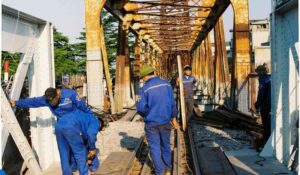
The Ministry of Road Transport and Highways (MoRTH) has invoked the newly introduced ‘Catastrophic Event’ provision against two highway developers following major structural failures and construction-related incidents on National Highway projects. The provision empowers highway-owning agencies to prohibit developers from participating in new projects for a period of two years and impose adverse performance ratings, potentially affecting their eligibility for future contracts.
One of the cases concerns the four-laning of the Poondiyankuppam–Sattanathapuram section of NH-45 (now NH-32) in Tamil Nadu, implemented under the Hybrid Annuity Model (HAM). On April 6, 2026, substantial settlement of the pavement quality concrete of approximately two metres was observed on the main carriageway at the approach to the light vehicle underpass at km 105+220 on the Kollidam Bypass, accompanied by bulging, cracking and horizontal displacement of the reinforced earth. The project was awarded under a concession agreement to Poondiyankuppam Sattanathapuram Section Private Limited, promoted by Oriental.
The second case relates to the widening and strengthening of approximately 45 km of NH-727B in Uttar Pradesh under the Engineering, Procurement and Construction (EPC) model. On March 25, 2026, during the lifting and erection of the reinforcement cage for a viaduct pier of the major bridge over the River Ghaghra, a portion of the cage collapsed and fell on workers present at the site, resulting in two fatalities and grievous injury to one person.
The consequences of invoking the provision extend beyond rectification of the affected infrastructure. Developers may face restrictions on future bidding and adverse performance ratings, while the mechanism also places greater emphasis on construction safety, structural integrity and accountability for failures during project execution.
The action signals a more stringent enforcement approach towards construction quality and safety in National Highway projects. It may have implications for concessionaires, EPC contractors, lenders and project consultants, particularly in relation to project supervision, quality assurance, contractual compliance and the potential impact of adverse performance ratings on future project opportunities.
The Bar Council of India does not permit advertisement or solicitation by advocates in any form or manner.
This website is meant solely for the purpose of providing general information and not for advertising or soliciting any work whether directly or indirectly. By accessing this website, www.foxmandal.in, you acknowledge and confirm that you are seeking information relating to Fox Mandal of your own accord. Further, any content provided in this website should not be construed as legal advice. We disclaim all liability for any consequences of any action taken by the user relying on content provided on the website.
By clicking on the “I Accept” button, the user acknowledges that:
To learn more about how we use cookies, please read our Privacy Policy